
Why the question itself is hard
You ask three vendors and get three answers: one quotes an "inventory system" for a low six figures in NT dollars, another quotes an "ERP" for ten times that, and the third tells you their inventory system *is* an ERP. The quotes differ by an order of magnitude, but you only have one problem — stock and books never reconcile.
The terms get used loosely, so it helps to draw the line first.
The difference in one sentence
An inventory system manages goods. An ERP manages the consistency between goods, money and books.
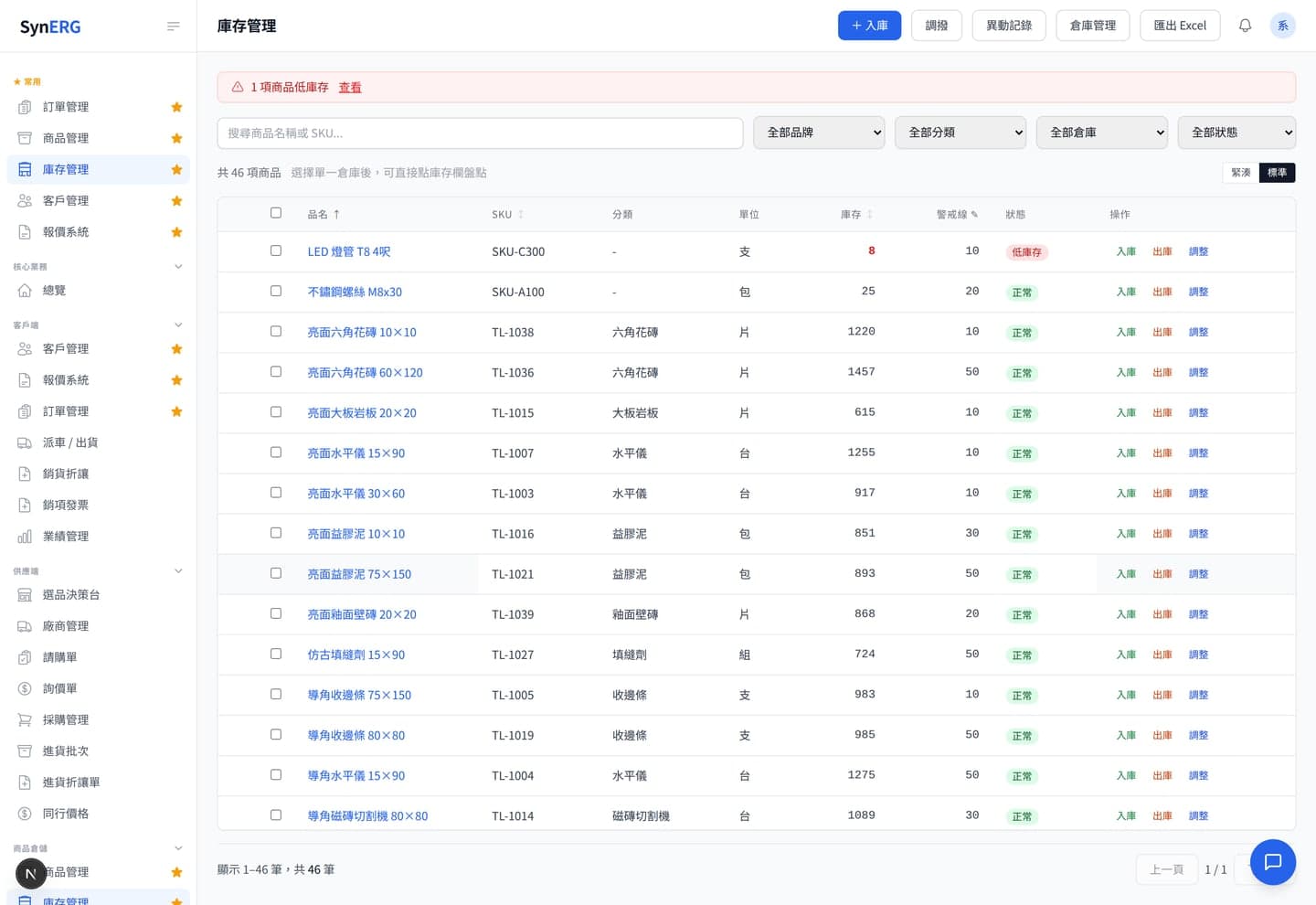
An inventory system answers: how much came in, how much went out, what is left, which warehouse holds it. It gets stock right.
An ERP answers: what did this batch cost, which purchase order does it belong to, how much remains payable, what was the gross margin this month, and does the inventory value on the financial statement match the physical count.
The difference is not the number of features. It is whether the data is one record or several.
Where they actually differ
| Dimension | Inventory system | ERP |
|---|---|---|
| Core concern | Correct quantities | Quantity, cost and books aligned |
| Stock | Yes | Yes |
| Purchasing & payables | Usually records orders only | Purchase orders create payables |
| Costing | Often a single purchase price | Weighted average, batch costing |
| Journal entries | None — booked separately | Generated from transactions |
| Financial statements | None | P&L, balance sheet, stock ledger |
| Multi-warehouse transfers | Partial | Standard |
| Implementation time | Weeks | Months |
| Price band | Around NT$100k | NT$hundreds of thousands to millions |
When an inventory system is enough
If most of these hold, do not rush into an ERP:
- A single sales channel
- Stable unit costs, little need for batch costing
- Bookkeeping handled by an external accountant who only needs sales and purchase detail
- One warehouse, or few transfers between warehouses
- Your real pain is "I do not know what is left", not "the books do not match the stock"
In that situation you will not use the accounting modules, so you are paying for features that never run — and the extra fields slow down daily work.
When you genuinely need an ERP
These signals mean an inventory system has hit its ceiling:
- The same stock is listed on several channels and quantities are reconciled by hand
- You need gross margin but cannot calculate it, because cost is spread across purchase orders, freight and duty
- Month-end close runs through a spreadsheet bridge between system and accountant
- Payables are tracked from memory or paper
- You must issue e-invoices, but the data has to be exported and re-entered elsewhere
What these share: data lives in two or more systems and you are the manual synchroniser in between. That is not fixed by adding a feature.
Our advice: do not jump the whole way at once
The most common failed start is switching on every module simultaneously. A steadier order:
- Get stock right first. Nothing downstream is accurate if stock is not.
- Then connect the channels. If you sell in several places, automating stock sync usually has the highest return.
- Book-keeping last. Journal entries need a clean source, which the first two steps provide.
SynERP's modules can be enabled in stages, so you do not have to buy everything on day one for things you might need later.