
VLM video recognition. A vision-language model reads existing CCTV and alerts on trolleys and cargo in lifts and on the guard desk.
- 01WHO IT IS FOR
- 02SYSTEM ARCHITECTURE
- 03PRODUCT SCREENS
- 04CORE FEATURES
- 05SPECIFICATIONS
- 06FAQ
- 07Contact
SynOne Vision — VLM Video Recognition
Vision-Language Model · Existing Cameras · On-premise GPU
SynOne Vision has its own product site with screens, modules and rollout details.
Visit synone.shengyiltd.comEverything on this page — who it fits, architecture, specifications and FAQ — as one PDF, with our contact details.
Conventional video analytics draws a box around “a person”. SynOne Vision uses a vision-language model that understands a scene and answers in words, so it judges situations: how many people are in the lift, whether there is a trolley, whether it is loaded, whether it belongs in this lift — or whether the guard has been away from the desk too long. It uses the cameras you already have, and the model runs on a GPU on site, with no per-call cloud API.
- Buildings that separate passenger and goods lifts
- Office
- Retail
- Industrial
Platform and hand trolleys or bulky cargo in a passenger lift raise an alert, while cleaning carts and similar can be allowed; a goods lift carrying people without a trolley can be flagged too.
- Committees and property firms that need eyes on the guard desk
A guard away from the desk beyond a set time, or apparently asleep during night hours beyond a set time, each raises an alert with a snapshot; looking down at a phone does not count as sleeping.
- Sites with CCTV that do not want to buy AI cameras
It reads the RTSP streams of your existing IP cameras; add one machine with a GPU, and the rules are tuned to the site.
Situations and alarm rules are set and tuned by us to each site’s needs. Cameras must see the whole lift car or desk. The production configuration is a Windows machine with an 8 GB NVIDIA GPU, with the model using about 5 GB of video memory; check other hardware with us first.
A cheap frame comparison runs first, and only changed scenes go to the model; the state changes only when consecutive answers agree, so a single bad frame does not trigger anything. Alerting events go to the SynOne alarm centre.
- Situations, not just boxes
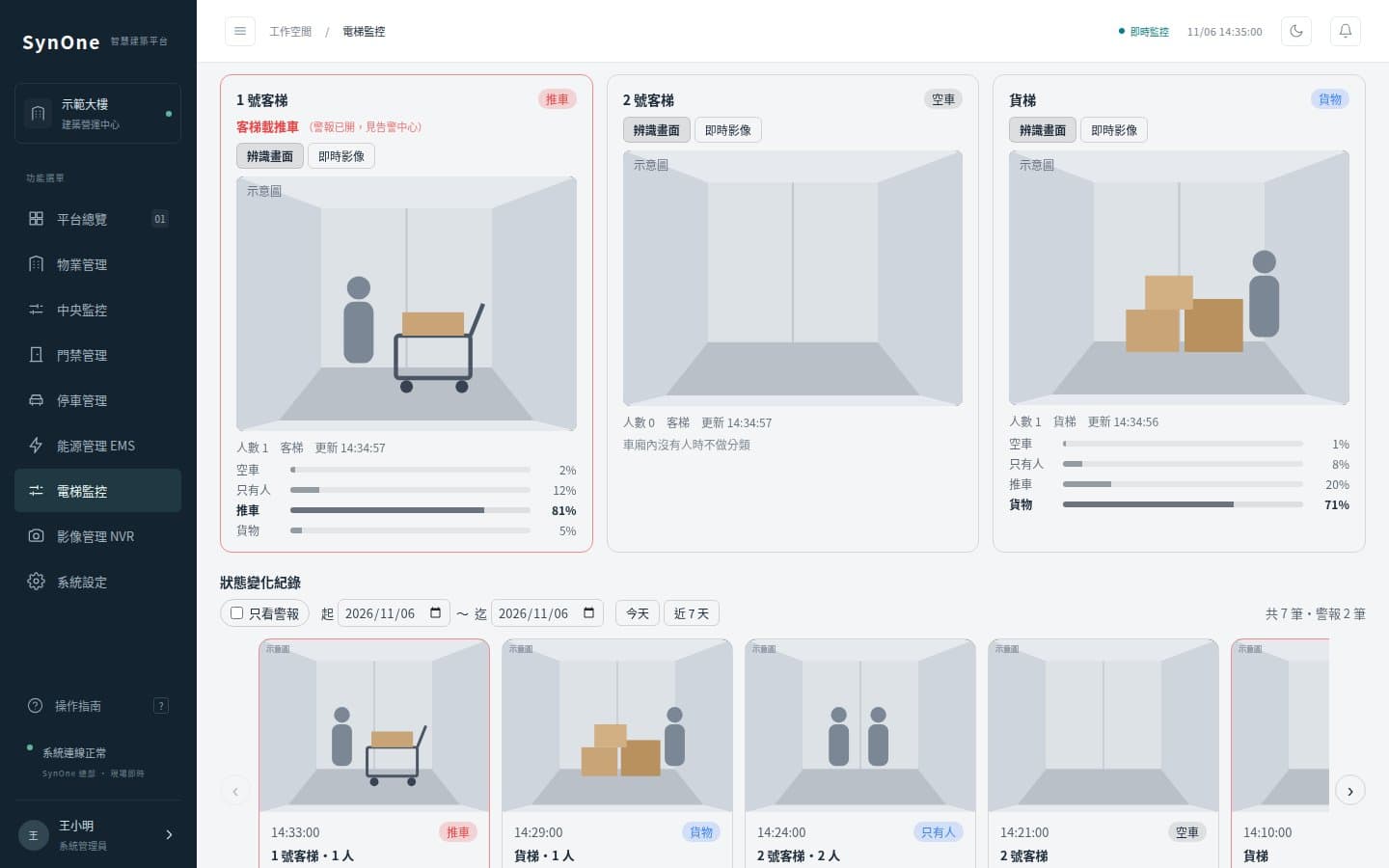
The model reports how many people are in the car, whether there is a trolley and what kind (platform, two-wheel, folding cart, cleaning cart…), whether it is loaded, whether there is bulky cargo, plus a one-line description — ignoring people outside the door, in the lobby or in mirror reflections.
- No change, no question
Thumbnails are compared first and the model is asked only when something changed — at most every 2 seconds per lift, with periodic re-checks even without change. The GPU idles most of the time.
- Majority vote against one-off errors
State changes only when most of several consecutive answers agree, and repeat detections in the same lift within 30 minutes merge into one alarm.
- Snapshots and an audit trail
Alarms pop up in the SynOne alarm centre with a sound, snapshot and AI description, and “acknowledge” is recorded; the change log filters by date or alarms only.
Vision uses the SynOne platform’s camera streams and alarm centre; situations can be added per site.
- ModelWhat it coversOpen-source vision-language model (Qwen3-VL 4B) on an on-site GPUNotesNo cloud API fees; no video sent to cloud AI.
- Lift carsWhat it coversPeople, trolley and type, loaded or not, bulky cargo; alerts for trolleys in passenger lifts and goods lifts used without oneNotesEach camera is set as passenger or goods lift; allowed trolley types are configurable.
- Guard deskWhat it coversAway from the desk beyond a set time; apparent sleeping in night hours beyond a set timeNotesCrop area, minutes and night hours are configurable; tell guards before enabling it.
- OutputWhat it coversAI panel on the lift page (recognition view or live video, red outline), alarm centre, change log with snapshotsNotesRecognition, lift alarms and desk alarms have separate switches; alarms are off by default.
- Production configurationWhat it coversWindows machine, 8 GB NVIDIA GPU; the model uses about 5 GB of video memoryNotesUnder about a second per frame; with many cameras, frames queue in turn.
| Item | What it covers | Notes |
|---|---|---|
| Model | Open-source vision-language model (Qwen3-VL 4B) on an on-site GPU | No cloud API fees; no video sent to cloud AI. |
| Lift cars | People, trolley and type, loaded or not, bulky cargo; alerts for trolleys in passenger lifts and goods lifts used without one | Each camera is set as passenger or goods lift; allowed trolley types are configurable. |
| Guard desk | Away from the desk beyond a set time; apparent sleeping in night hours beyond a set time | Crop area, minutes and night hours are configurable; tell guards before enabling it. |
| Output | AI panel on the lift page (recognition view or live video, red outline), alarm centre, change log with snapshots | Recognition, lift alarms and desk alarms have separate switches; alarms are off by default. |
| Production configuration | Windows machine, 8 GB NVIDIA GPU; the model uses about 5 GB of video memory | Under about a second per frame; with many cameras, frames queue in turn. |
- Do we need AI cameras?
- No. It reads the RTSP streams of existing IP cameras, provided they see the whole lift car or desk. You also need a machine with an NVIDIA GPU to run the model.
- Is video uploaded to the cloud?
- No video goes to any cloud AI service — the model runs on the site’s own GPU. Alarm snapshots are stored on the site server and visible only to platform accounts with camera rights.
- Can it recognise other situations?
- A vision-language model is told in words what to judge, so a new situation does not require retraining. Lifts and the guard desk are in production today; tell us what else you need and we will assess it, set it up and test it on site before it goes live.
- How accurate is it?
- It depends on camera angle, lighting and the situation, so we do not quote a universal percentage. On rollout, recognition runs with alarms off while every situation is tested on site, and alarms are enabled only once the judgements meet the need.
Each product can be bought on its own; on one SynOne platform they share accounts, alarms and the same people, door and device records.
Licensing
Sold under a perpetual licence for one site and one server, bound to that server’s hardware by a digitally signed licence file. Copying it to other machines or sites, reselling or lending it, reverse engineering it or circumventing the licence check is prohibited, and infringements are pursued under the Copyright Act. Full licence terms (Chinese) →
- Company
- SHENGYI CO., LTD. 陞釔有限公司
- Tax ID
- 62222816
- Address
- 7F., No. 3, Ln. 70, Anmin St., Xindian Dist., New Taipei City, Taiwan
- Phone
- 02-8666-3131
- contact@shengyiltd.com
- Service hours
- Monday to Friday, 09:00–18:00
https://shengyiltd.com